Canada took a historic step in October 2025 by announcing the new Financial Crime Agency and the Code of Conduct for the Prevention of Economic Abuse. This announcement is a major milestone towards improving Canada’s current financial system to be safer for all. The Code of Conduct provides an opportunity to transform how financial institutions, regulators, and service providers address economic abuse and financial harm. It gives them clear expectations for how financial institutions can identify, prevent, and respond to economic abuse and for clients to receive adequate support in a standardized way.
Overseen by the Financial Consumer Agency of Canada (FCAC), the Code will be developed in collaboration with financial institutions and key stakeholders, including CCFWE.
Drawing on the United Kingdom’s Financial Code of Practice model, CCFWE has long called for a similar minimum standard in Canada to protect victim-survivors of economic abuse and reduce risks of fraud and financial control by abusive partners.
CCFWE’s research has shown that financial institutions are often the first point of contact for victims disclosing economic abuse. Stigma, shame, and fear of not being believed prevent many from coming forward to family members or friends. Financial institutions therefore play a vital role in early prevention and in supporting survivors on their path toward economic safety and recovery.

“In Canada, 96% of domestic violence survivors experience economic abuse through coerced debt, identity theft, or destroyed credit, yet these crimes often go unseen. Economic abuse can have a devastating effect on survivors, directly impacting their mental health, physical safety, independence, financial well-being, and ability to leave an abuser. CCFWE welcomes this historic action by the Government of Canada and looks forward to continued partnership with policymakers to advance systemic solutions to economic abuse.”
– Meseret Haileyesus, Founder and Executive Director
Since 2020, CCFWE has engaged in sustained dialogue with the Financial Consumer Agency of Canada (FCAC) and members of the National Task Force for Women’s Economic Justice to advance the development of a Code of Conduct on the Prevention of Economic Abuse. As Canada’s recognized national leader on economic abuse and coerced debt, CCFWE has played a central role in driving systems transformation toward survivor-centred financial safety.
The examples below highlight how CCFWE, as a survivor-driven organization, has collaborated with government, regulators, and sector partners to help create meaningful institutional change and safer financial services for survivors across Canada.
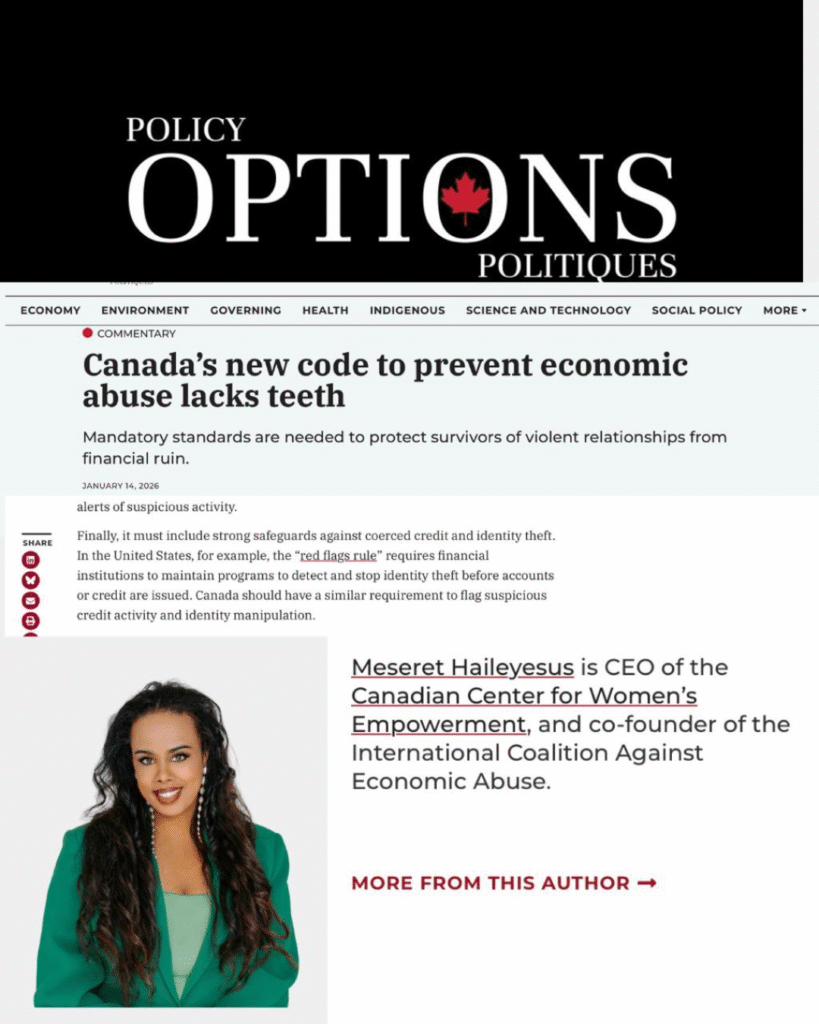
Meseret Haileyesus: Canada’s new code to prevent economic abuse lacks teeth:
https://policyoptions.irpp.org/2026/01/economic-abuse-prevention/
As the Code of Conducts gets developed, CCFWE will work together with the government, FCAC and CBA to ensure that the code of conduct will be guided by lived expertise, is trauma- and violence informed, and survivor-centred.
As a survivor-led and survivor-driven organization, CCFWE will also call for the strongest possible protections for survivors, including the adoption of mandatory frameworks that ensure accountability across the public and private sectors. Given the announced voluntary nature of the Code, CCFWE will continue promoting stronger implementation and oversight measures to ensure the highest protection for survivors’ financial security.
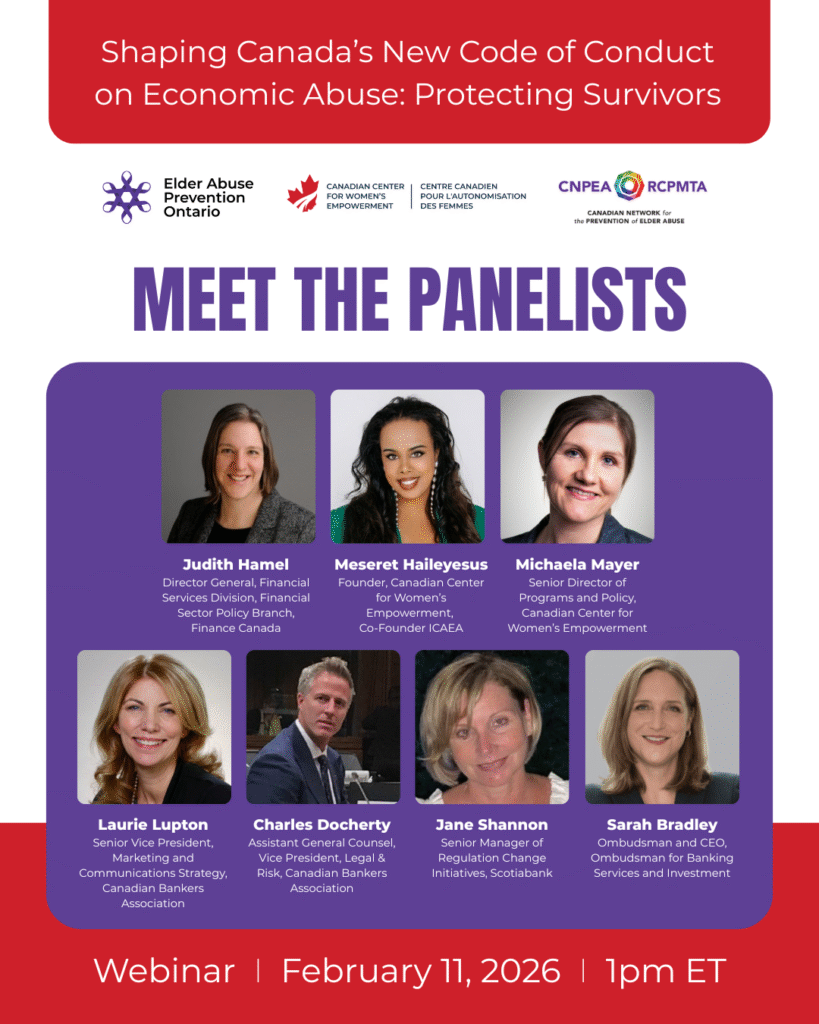
Panel discussion: “Shaping Canada’s New Code of Conduct on Economic Abuse: Protecting Seniors and Survivors.”
Date and Time: Wednesday, February 11, 2026, 1pm EST
Location: virtual
This panel will explore the newly announced Code of Conduct on the Prevention of Economic Abuse and its implications for survivors, as well as how it will shape the way financial institutions recognize and respond to economic abuse. The discussion will also examine the existing Code of Conduct for the Delivery of Banking Services to Seniors, its origins, key components, and the internal changes it prompted within financial institutions.
Bank representatives will share insights into current practices under the seniors’ code, while survivors will offer lived expertise from both senior abuse and domestic/economic violence perspectives. Together, the panel will assess the real-world impact of the seniors’ code, highlight best practices, and identify lessons that can guide the development of the new economic abuse code of conduct.
Bringing together survivors, bank and financial industry representatives and policymakers, this session will provide participants with a clear understanding of the current seniors’ code, the realities of economic abuse, and how the Code of Conduct on the Prevention of Economic Abuse can shape a safer financial future for survivors.
Learning objectives:
Make sure to subscribe to our newsletter below to stay updated on any developments on the Code of Conduct.
Have questions or want to collaborate?
Please email Michaela Mayer at [email protected]