16 Days of Activism Against Gender-Based Violence

UNiTE to End Digital Violence and Break Barriers in Housing and Economic Safety

UNiTE to End Digital Violence and Break Barriers in Housing and Economic Safety

This year, CCFWE joins the global UNiTE to End Digital Violence Against All Women & Girls movement through our Help Us Rise 2025 campaign: Combating Barriers in Housing Security and Economic Safety.


Across Canada, survivors of economic abuse face systemic barriers to housing, safety, and independence. Join us in taking action to make housing and economic systems truly safe, accessible, and empowering for all. 


Together, these themes remind us of a shared truth:

Digital safety, housing security, and economic safety are all connected, and essential for ending gender-based violence.


Explore the Help Us Rise campaign

Sign the Pledge

Share the Social Media Toolkit

Endorse the Calls to Action from our Femicide Policy Brief

Economic Abuse, Digital Violence, and the Right to a Safe Home

Economic abuse is a form of family and gender-based violence that involves control, exploitation, or sabotage of a person’s economic resources, assets, and opportunities to undermine their independence and security. It can include coerced debt, stolen assets, restricted access to income, or blocked employment opportunities.

Today, much of this control happens through digital systems, online banking, e-transfer misuse, financial monitoring, and online harassment. These digital forms of economic abuse prevent survivors from safely managing money, accessing credit, or participating fully in the economy.

For many, this also means being shut out of stable housing. Without access to safe digital tools, banking services, or credit, survivors face additional barriers when trying to find or keep housing. This is where the global and national themes meet: Ending digital violence and economic abuse is essential to building a Canada where housing is safe, accessible, and empowering for all.

Read More Read Less

16 Days, One Collective Goal

Throughout the 16 Days of Activism, CCFWE is working to:
  • Highlight the link between economic abuse, digital safety, and housing insecurity
  • Promote survivor-centred, trauma-informed housing and financial policies
  • Address intersecting barriers faced by Indigenous, Black, racialized, newcomer, disabled, and 2SLGBTQ+ survivors
  • Impact system change that protect survivors’ autonomy and privacy
  • Empower Canadians to act because the right to housing applies to all

How to Get Involved

  1. Sign the Pledge: Stand with survivors and commit to ending economic abuse and digital violence. 
  2. Share the Campaign: Use our Help Us Rise 2025 Social Media Toolkit to spread awareness during the 16 Days.
  3. Learn More: Read our Economic Abuse & Housing Factsheet to explore the campaign’s key findings and calls to action.
  4. Endorse the Calls to Action for our Femicide Brief: Femicide in Ottawa and Beyond: A Call for Coordinated Policy and System Change.
  5. Join the Conversation: Bring the topic of digital and economic safety into your community, classroom, or workplace.
  6. Follow CCFWE: Join the discussion on LinkedIn, Instagram, Facebook, and X.

Housing is not just about affordability, it is about dignity, safety, and stability.
Women and gender-diverse people are among the fastest-growing unhoused populations in Canada, yet their experiences remain hidden in data and policy.

By combating barriers in housing security and economic safety, we can ensure that survivors have the opportunity to rebuild their lives and thrive.

Because when housing, economic, and digital safety come together, we all rise.

16 Days, 16 Ways to Reflect on Home

Instead of listing 16 types of abuse this year, we’re inviting 16 reflections you can use in your work, your conversations, and your advocacy. Use them as prompts to talk, post, write, or simply think:

  1. Home as safety, not just shelter. 
  2. Home has freedom from control over money, credit, and work.
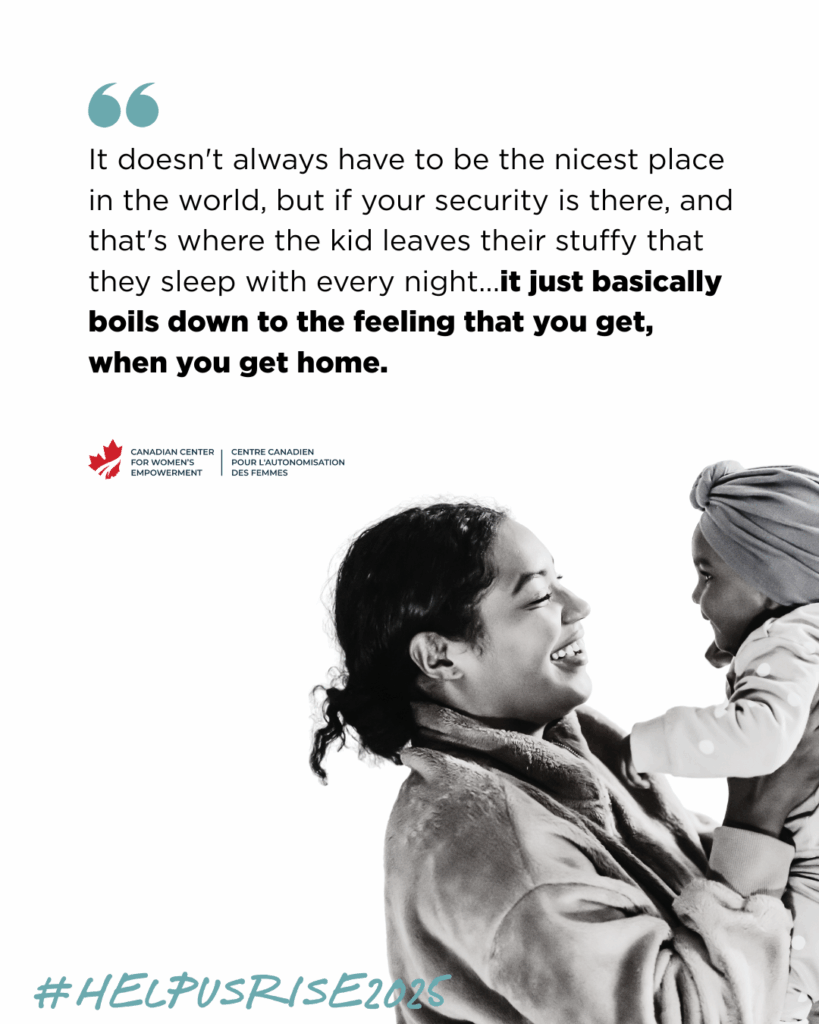
  3. Home as a place where children can sleep without fear. 
  4. Home as the ability to sign a lease in your own name.
  5. Home as not having to choose between rent and safety.
  6. Home as being believed when you explain why your credit report looks the way it does.
  7. Home as a lock only you decide to change. 
  8. Home as not having debt you never consented to follow you to every application.
  9. Home as accessibility for survivors with disabilities.
  10. Home as a culturally safe space for Indigenous, Black, racialized, newcomer and 2SLGBTQ+ communities. 
  11. Home as time not being rushed out of shelter before you’re ready.
  12. Home as no one is tracking your address through shared accounts or bills.
  13. Home as the right to return to school or work without losing your roof.
  14. Home as systems that know the difference between coerced debt and “bad choices.”
  15. Home as a future you can plan for, not just a crisis you’re surviving.
  16. Home as a right, not a reward. 


Read the 16 Reflections Read Less

How CCFWE Shows Up During the 16 Days

Throughout the 16 Days of Activism, CCFWE will be:

  • Sharing survivor-informed content on housing and economic abuse across our social media channels
  • Featuring tools and stories from our Help Us Rise 2025 campaign
  • Featuring our work and different programs
  • Highlighting partners and allies working at the intersections of housing, gender-based violence, and economic justice
  • Pointing to practical resources that frontline workers, advocates, and community members can use in their own work 

How You Can Take Part in the 16 Days with CCFWE

Whether you’re an individual, a community organization, or an institution, you have a role in making housing safer for survivors of economic abuse.


Here are some ways to get involved during the 16 Days:


  • Share Help Us Rise content on your channels to spark conversations about housing and economic abuse.
  • Use our social media toolkit to post ready-to-use graphics, captions, and prompts.
  • Sign and share the CCFWE pledge to stand with survivors of economic abuse.
  • Host a conversation in your workplace, classroom, or community group about how housing systems can better respond to survivors.
  • Connect with local shelters, housing providers, and anti-violence organizations to learn how you can support their work.


Small actions add up. Every share, every conversation, every policy change moves us closer to a Canada where survivors can access a safe home and rebuild their economic lives.